
10 October 2025
The screening of This is Not Chinatown (Aly Amer, Yanbo Hao, Emiel Martens, Philip du Plessis, Elsie Vermeer, Yiwen Wang, to be concluded) at Vox Pop (University of Amsterdam) served as the kickoff event for the research project Chinese Selfies in Europe,which investigates various forms of migration, representation, and cultural expression in relation to the ‘newest’ generation of Chinese moving to Europe. The event was well attended, drawing students, faculty, and members of the wider community, and sparked a lively discussion. This large crowd reflected both the relevance of the themes addressed in the film and the continuous public interest in questions of migration and belonging in Dutch and Chinese contexts specifically, and more broadly, on European and global scales. The documentary clearly resonated with its audience, while others also posed some critical questions. The more critical perspectives on the film make it an instructive case study for reflecting on (the politics of) representation of various forms of migration in contemporary Europe.
This is Not Chinatown presents a portrait of a small circle of Chinese international students living in Amsterdam. Following six friends, the film foregrounds themes of belonging, mobility, and friendship in a transnational context. As such, the project contributes to broader discussions on migration and cultural expression in the Netherlands, as well as in transnational Chinese communities.One of the most striking qualities of the documentary, we found, lies in its departure from the conventional representational strategies often employed in films addressing similar themes. Whereas such works tend to emphasise ‘difference’ or ‘victimhood’ through an art-house aesthetic, this film does not. Instead, its narrative is clear, the interview settings minimalist, and the b-roll remains notably neutral.
What is more, the makers of the film were kind enough to invite all attendees to become part of the production process, since the documentary was unfinished. This incompleteness opened up a space for reflection on the very process of documentary-making. Engaging with a production still in development made us witness the uncertainties, compromises, and choices that shape nonfiction film (if we want to make a clear distinction between fiction and non): decisions about framing, about whose voices to amplify, and possibly most crucially, which themes to underline and repeat, and which topics to leave out. It also emphasised how precarious the act of representation can be, especially when dealing with migrating individuals whose histories and identities are already subject to competing claims, while they are in fact hardly ever reducible to a storyline. The unfinished character of the film thus became a strength, inviting the audience to think not only about the story being told, but also about the broader mechanisms and difficulties of telling it.
The unfinishedness of the film also made it an easy target for critique. We do not intend here to ‘attack’ the makers brave enough to invite us to partake in their clearly difficult production process. While we like to address some criticisms, they are by no means directed towards the makers. Being up-close to the interview and framing process simply made us aware of a few very interesting points of concern related to researching ‘people’, and to the matter of representation.
Below, we introduce four interrelated matters that we intend to problematise for discussions sake: 1) the implications of the documentary’s title and the historical context of its Chinese translation, 2) the narrowness of its representational scope, 3) the lack of critical engagement in its method, and 4) its conceptual ambiguity.
RH: A first concern lies in the question of naming. By titling the film This is Not Chinatown, the filmmakers invoke a diasporic signifier long associated with earlier waves of Chinese migration to Europe, which is also amplified by the choice of title’s corresponding Chinese translation: 这不是唐人街. ‘Chinatown’ here functions not only as a geographical space but also as what Stuart Hall (1990) calls a ‘signifier of identity’, a condensation of historical memory and cultural visibility: Zeedijk – the Amsterdam’s ‘Chinatown’ – is historically closely intertwined with the hustling life of (Indonesian/Surinamiese-)Chinese worker migrations with a Cantonese descent (Rath et.al., 2017). Some of its oldest Cantonese restaurants and tokos1 have survived the difficult period of the 1970s, when the neighbourhood was occupied by drugs deals and gangs who caused severe security concerns. Despite Zeedijke’s nowadays diversified landscape including various non-Cantonese/Chinese businesses, the old shops’ continuing presence stands as a living testament to the cross generational ties between this neighborhood and the Chinese diaspora community. Yet the film’s protagonists – Mandarin-speaking recent arrivals in Amsterdam pursuing higher education- occupy a very different position from the working-class migrants who built those earlier communities. They also approach the region as temporary nostalgic consumers. With such distinction, it is therefore no surprise for these students to find limited resemblance of themselves in ‘Chinatown’. However, it is also a great shame to leave the reasons behind this sense of alienation unaddressed. To disavow ‘Chinatown’ while simultaneously invoking it risks erasing the historical struggles of a prior generation. It also raises the issue of authority: who has the right to claim or disclaim ‘Chinatown’, on whose behalf is such a claim made?2
This topic came up when an interviewee stated in the documentary that ‘this is not Chinatown’ because of its size – Zeedijk is merely a street instead of a town. After the screening, an audience member pointed out that the literal translation of “唐人街 (Tangren jie)” – as adopted in the title – is ‘Tang (dynasty) people street’, questioning the choice of this term instead of the literal translation of ‘Chinatown’ – “中国城 (zhongguo cheng)”. Interestingly, this concern was overlooked despite two of the four of us, the panelists, having a sinophone background. According to various sources (see ChinaNews3, TaiwanParonama4, Encyclopédie du MEM5), 唐人街 is more historically and widely adopted in sinophone contexts referring to Chinatown: written records of associating Chinese migrants with Tang trace back to the early Qing Dynasty (late 17th century), originating from the Japanese term for Chinese enclaves starting from the prosperous Tang Dynasty period (618-907). This was later commonly adopted by Chinese diaspora, and eventually into 唐人街 coined by Cantoense merchants (Zhi, 1868). The term 中国城 appeared in Chinese-language sources at a later stage, adopted by multilingual elites as the direct translation from the English word ‘Chinatown’ (see Cai, 1933, p12; Lee, [1975] 2010). Nowadays, despite both words being commonly used as the translation for ‘Chinatown’ – regardless of its size. However, during this event, its slight linguistic difference still generated interesting questions. For me, as someone raised in a Cantonese cultural context, it is instinctive to associate the other panelists’ default use of 唐人街 for ‘Chinatown’ with our shared Cantonese-language background, shaped in part by its diasporic influence. Circling back to the previous critique, this translingual matter highlights the documentary’s potential in exploring tensions between old and new generations of Chinese migrants.
LL: The second issue concerns the matter of representation. The film presents one homogenous group of friends, all of whom share similar social and educational trajectories. This amplifies the already existing problem Benjamin Maiangwa (2023) describes as the ‘paradox of diasporic identity’, and Rey Chow (1991, xvi) as ‘prescribed “otherness”’: the tension between the demand for representation of difference and the impossibility of any single group embodying the full heterogeneity of a diasporic formation. Ian Ang (2001, 30) illustrates this with the following anecdote:
[I]t was one day that a selfassured, Dutch, white, middle-class, Marxist leftist, asked me, ‘Do you speak Chinese?’ I said no. ‘What a fake Chinese you are!’, was his only mildly kidding response, thereby unwittingly but aggressively adopting the disdainful position of judge to shift ‘real’ from ‘fake’ Chinese. In other words, in being defined and categorized diasporically, I was found wanting.
By narrowing its focus, the documentary risks conflating the experience of privileged, mobile students with ‘Chinese life’ in Amsterdam more broadly. This overlooks other voices within the ‘Chinese presence’ in the Netherlands, including long-established families, undocumented migrants, and workers within different social contexts.
At the same time, this point of critique is problematic in itself. Apart from the title of the documentary which invokes a specific ‘type’ of migrant living within the Netherlands, no other open claim of ‘summarising’ or identifying ‘the’ experience of Chinese students in the Netherlands could be found in the film. Any representational weight it seems to carry is therefore less the filmmaker’s claim than the viewer’s own projection. As such, the film invites the viewer to become aware of this quest for ‘order’ and their need to ‘summarise’ a plurality of voices and societal positions into one.
RH: Moreover, the film’s methodological approach is characterised by a hesitant critical engagement. While the emphasis on the students’ own voices might be understood as an attempt at participatory representation, the interviews are framed in ways that leave little room for analytical depth. Questions such as why does the film focus this particular group of students, what are the standards for selecting and editing, what message does the documentary try to convey, who is the target audience, why is it valuable for them, are absent. As Stuart Hall (1997) reminds us, representation is never a neutral act but always a site of power, where inclusion and exclusion are negotiated. By leaving the students’ accounts largely uncontextualised, the film risks reproducing surface-level narratives of cosmopolitan selfhood without interrogating the broader structures that shape those narratives. Without clearly stating the producer’s creative intention and rationale behind the production, it underplays the documentary’s potential of tackling extradiegetic societal issues related to the students specifically, as well as the population it intends to centralise.
The Dutch context further complicates the reception of This is Not Chinatown. As Gloria Wekker (2016) illustrates, the ways in which many Dutch citizens envision themselves are marked by a paradox: on the one hand, they recognise a persistence of colonial histories and racialised structures, while on the other hand, a dominant self-image consists of tolerance and colorblindness. The absence of a critical framework in the film risks reproducing precisely this paradox. In this case, it might be the producer’s overt awareness of power hierarchies informed by racial difference that led to an un-critical approach toward the topic, avoiding overtaking the space created for Chinese students by inserting his own opinions. This assumption comes from a short confrontation between the producer and myself (Rui, Chinese): while I expressed my critique towards these Chinese students claiming that ‘this is not Chinatown’ while being oblivious of its significance for the diasporic community, the producer replied that it was his intention to respect the perspectives of interviewees and therefore, he refused to put them under the target of attack. Now, taking our own positionality into account and talking about this, we realise how ones’ positionality could determine researchers’ comfortability with a critical approach to the topic, which was taken for granted at the moment of discussion.
Such intention speaks to the concept of ethics of care – a genuine intention of doing no harm to research participants – in conducting qualitative research, addressing the dilemma of power relation between researcher and informants, and how these different roles have an effect on knowledge creation. Regardless of a more critical (see Hammersley and Traianou, 2014) or supportive (see Reich, 2021) examination of the ethics of care, the researchers’ clear positionality is emphasised as essential in good knowledge production. According to Small, “Reflective or not, there is always some representation of the observer…it is here where lack of reflection has led to inadvertent stereotypes and worse.” (2015, but see Reich, 2021, p579). Therefore, while admiring the producer’s strong sense of care towards his interviewees, a critical examination for his own role in this documentary – thought at first glance might seem to take up space intended for students – would in practice help contextualise the lived experience of interviewees students. As This is not Chinatown is one of few documentaries dedicated to Chinese students’ lives in a European context, and taking into account the producers’ absence of previous affiliation with Chinese culture, this has the great potential of drawing out cross-culture dialogues that currently remained underexplored for a wider general public.
LL: Finally, the documentary also suffers from a lack of conceptual clarity. It goes back and forth between generic questions and specific themes (which also comes from a previous interest in ‘mobility’, linked to a university project out of which this film was developed) without clearly articulating its stakes. The audience is left uncertain as to whether the film is about Chinese forms of migration as a contemporary specificity, its underrepresentation in the Dutch context, or simply about the universal experience of studying abroad. This ambiguity dilutes its analytical contribution.
RH&LL: In sum, This is Not Chinatown illustrates both the promise and the pitfalls of contemporary documentary approaches to migration. As Stuart Hall (1990, 225) reminds us, identity is always a matter of becoming rather than being; the challenge for documentary is to illuminate this process rather than obscure it. At the same time, the documentary as presented to us was itself in a state of becoming rather than being, and as such, it might have been in its most honest, and interesting, stage.
Footnotes
1 Toko: ‘shop’ in Indonesian; a kind of retail shop commonly seen Indonesia and the Netherlands.
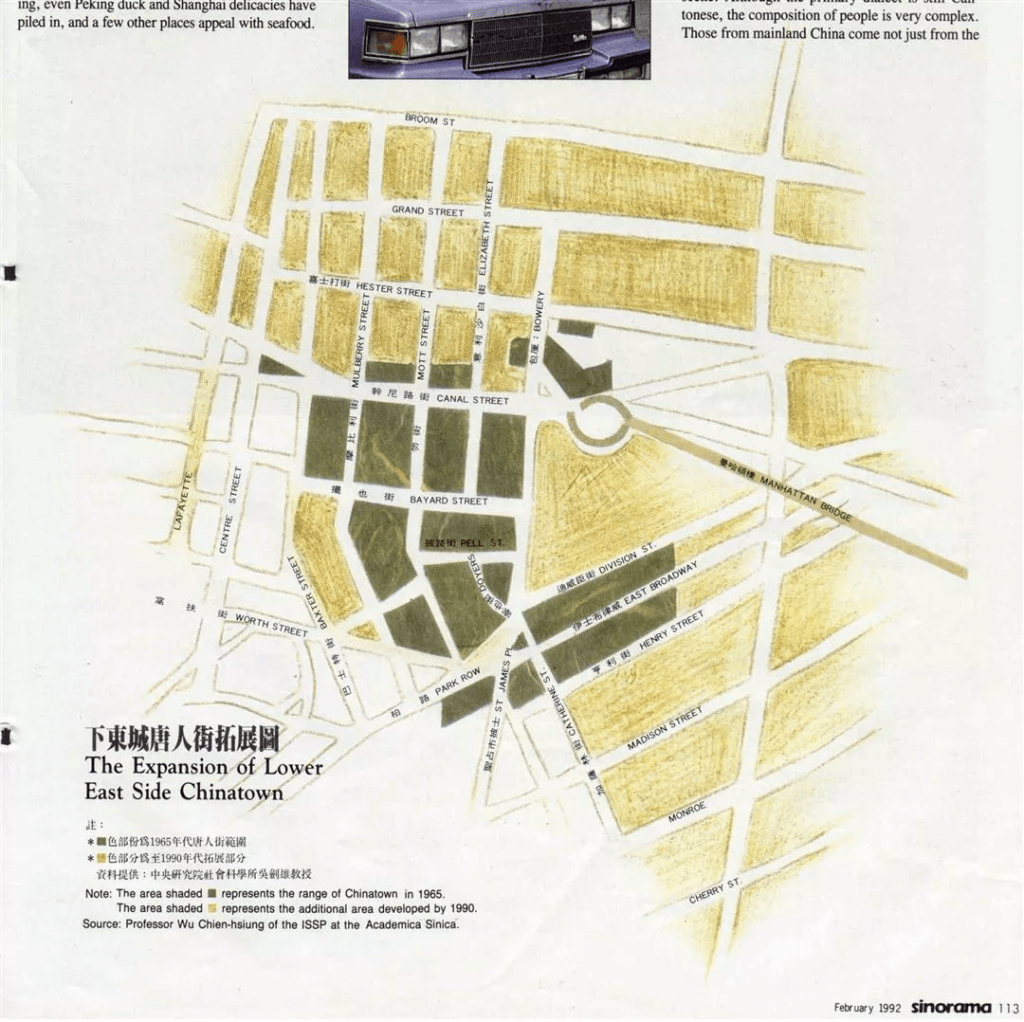
2 Map of New York’s Chinatown (1968-1990), sourced from Taiwan Panorama (see footnote 4).
3 “唐人街”前世今生:从“大唐街”到“中国城”, 2009, ChinaNews, Last accessed on 24th Sep., 2025.
4 “永遠的「唐人街」?” by Chen Shumei, 1992, Taiwan Panorama. Last accessed on 24th Sep., 2025.
5 “中国城:满地可唐人街”, by Olivier Paré, 2017. Last accessed on 24th Sep., 2025.
References
Ang, Ien, 2001. On Not Speaking Chinese: Living Between Asia and the West, Routledge
Chow, Rey, 1991. Woman and Chinese Modernity, University of Minnesota Press
Cai, Yunchen, 1933. Lv’e riji ejing lvhua hekan 旅俄日記·俄京旅話合刊 [=Travel Diary in Russia· Travel Talks in Moscow].
Hall, Stuart, 1990. ‘Cultural Identity and Diaspora’, in Jonathan Rutherford (ed.), Identity: Community, Culture, Difference, Lawrence & Wishart
Hall, Stuart (ed.), 1997. Representation: Cultural representations and signifying practices. Sage Publications
Hammersley, M., & Traianou, A, 2014. ‘An Alternative Ethics? Justice and Care as Guiding Principles for Qualitative Research’, Sociological Research Online, 19(3), 104-117
Lee, Ou-fan, 2005. Xichao de bi’an 西潮的彼岸 [= Notes From the Other Shore], Nanjing Shi : Jiangsu jiao yu chubanshe 南京市:江苏教育出版社. Originally written in 1975.
Maiangwa, Benjamin (ed), 2023. The Paradox(es) of of Diasporic Identity, Race and Belonging, Palgrave Macmillan
Reich, J.A., 2021. ‘Power, Positionality, and the Ethic of Care in Qualitative Research’, Qual Sociol, 44, 575–581
Rath, Jan, Annemarie Bodaar, Thomas Wagemaakers, and Pui Yan Wu, 2017. ‘Chinatown 2.0: The Difficult Flowering of an Ethnically Themed Shopping Area’, Journal of Ethnic and Migration Studies, 44 (1): 81–98
Wekker, Gloria, 2016. White Innocence: Paradoxes of Colonialism and Race.
 Chinese Selfies in Europe