
Made in China – World Museum Amsterdam by Xu Yiqin
1 June 2026
Remaking the Narrative of Creativity and Industrialization
This is my second time at the Wereldmuseum in Amsterdam after a rather rushed previous visit, so I took another look at the permanent exhibition area before heading to the “Made in China” exhibition. I like the classic architectural style of this building, which was originally built to celebrate colonization but now aims to rethink history and world culture through a decolonial lens. Perhaps because Chinese New Year had recently passed, the red lanterns from the festivities were still hanging in the main hall. This traditional Chinese element creates a distinctive contrast with the building’s generally western and somber atmosphere. Positioned directly opposite the lanterns, the “Made in China” poster is displayed on the second floor.
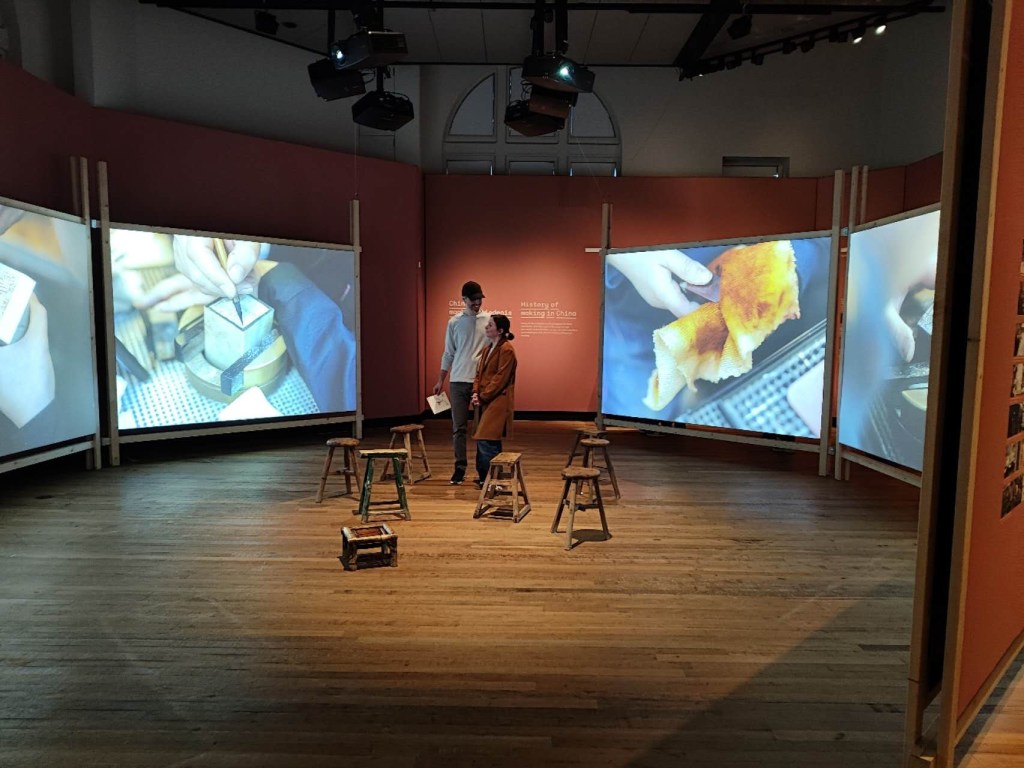
Stepping into the exhibition’s first section, a circular space surrounded by projected screens was furnished with wooden stools (木板凳) that exuded a “Chinese dream core (中式梦核)” vibe (figure 1). While such stools are ubiquitous and unremarkable in rural China, seeing them in a Dutch museum felt surprisingly fresh. Crafted without nails using traditional mortise-and-tenon joints (榫卯), they embody a simple yet pragmatic craftsmanship; however, these kinds of artifacts seem to have been replaced by modern alternatives in today’s cities. Seeing these small, worn-down stools, with their exposed wood texture, reminds me of elderly people sitting in Chinese rural courtyards, cracking sunflower seeds or sorting vegetables. I can’t help but wonder where they brought these aged pieces from. I also noticed a map of China marked with the locations of the crafts and industrial developments mentioned in the exhibition (Figure 2). I am quite familiar with this map, but my European friend asked me why the Northwest region was only noted for its raw material resources like coal, gas, and jade, while the Northeast region of China was not mentioned at all. Perhaps the Northeast represents the old industrial “Made in China” (heavy industry/state-owned), which doesn’t fit the museum’s “craft/creative” narrative. This omission echoes the museum’s description in its permanent exhibition that colonial knowledge transfer often rendered certain local realities “invisible.” Does this mean that the representation of “making” featured in the exhibition is based on a romanticized vision? This question led me to examine the map’s details more closely, and I began to wonder about the exhibition’s focus on “Making/maker”: How does it define and distinguish between Chinese craft, industry, and art? Which of these domains do the selected artifacts and topics aim to understand and interpret?
In the same room, there is a chronological “History of Making in China.” For the ancient period, it emphasizes “the oldest” and “the first,” showcasing inventions from China. However, the display of modern history after the nation’s founding feels somewhat rushed: in the historical timeline, for example, the Reform and Opening-Up and the wave of industrialization from the 1980s are only mentioned in a single sentence. However, the past few decades have actually shaped the “Made in China” label. During this phase, “making” became dynamically intertwined with the economy, politics, and society at large. The crafts and manufactures are influenced by national and local policies, and are also more closely integrated with export trade. Interestingly, the final entry stops at 2016, mentioning that China has over 300,000 design graduates annually. Compared to the historical stages or significant events in other entries, my interpretation of this particular mention is: a massive number of design graduates are flooding into the job market; perhaps most cannot pursue creative artistic work, instead becoming part of the “Made in China” manufacturing wave. I believe these statistics actually hold many vivid stories and may resonate with the exhibition’s final section titled “Makers of Today.” Will those young graduates become artists, craftspeople, or workers in today’s China?
Perhaps influenced by the curator’s academic background, I found that this exhibition places a strong emphasis on the materials used in the making process. For instance, in another impressive section, the display is guided by “materials and techniques” rather than the conventional approach of organizing exhibits by theme or timeline. Although I was a bit confused by this way of guiding the visitors’ movement when I first visited, upon revisiting this time, I found it might also be an iterative and flexible way of presenting. This section also features many tactile, visual, and video-based interactive pieces, for example, touching a calligraphy brush (毛笔), mahjong tiles (麻将牌), and a lacquer vase. I think this offers an engaging experience for non-Chinese visitors. My foreign friend lingered for a while at the “Chinese Characters” digital interaction, trying to “piece together” characters by combining radicals. But afterward, he asked me: how does this relate to making or craftsmanship? The exhibit’s introduction mentioned that Chinese characters and calligraphy show “how repetition can be used creatively and systematically to produce thousands of unique characters.” I find this interpretation of Chinese characters to be very interesting and insightful, offering me a different perspective. But as a native speaker, I still find this claim a bit puzzling: Chinese characters, just like the alphabet’s letters, are a written form of language. Perhaps from a Western perspective, Chinese characters are viewed as “graphics” rather than “symbolic/semantic” forms. In the context of alphabetic systems, logograms become “products” to be decomposed. I believe this is a way to help non-Chinese audiences understand characters, but not to be regarded as “a means of production”. While the museum’s permanent exhibition claims to value “Native Knowledge”, the digital interaction seems to revert this by deconstructing a non-Western language into a visual curiosity rather than a carrier of complex wisdom.
In the “mass production” section, the exhibition clearly places greater emphasis on the industrial aspect. What struck us was the consequences of industrialization for China (“At what cost?”), particularly regarding labor conditions and environmental impact. In China, industry and manufacturing have conventionally been granted a “near-sacred” status through political propaganda: they embody the value of “Workers as Masters” (工人阶级当家作主), and rapid industrial growth is viewed as success in modernization. I greatly appreciate how this exhibition gathered specific stories of individuals, because what is often overlooked behind mass-produced commodities are the stories of real people, especially their struggles and reflections. At the same time, however, this may reinforce the stereotypes associated with “Made in China”—resource depletion, labor exploitation, and unsustainability. As far as I know, these issues have been repeatedly highlighted in Western media. While I believe it is essential to acknowledge these negative impacts and seek for possible solutions, I also think they are often exaggerated for geopolitical interests. Although the “costs” of production should be widely acknowledged, it simplifies China’s role as a global infrastructural builder and manufacturer. As a developing country, China has indeed encountered numerous detours and setbacks during its industrialization over the past few decades. However, this is not merely a problem faced by a single nation; as the “world’s factory,” it bears the costs for the supply chains of the Global North. Instead of placing Western-led critiques of development at the center, the exhibition could further explore the complex realities of the shifting global power dynamics. Environmental and labor rights issues have gained widespread attention in China, as people begin to confront real-world challenges beneath the “National Rejuvenation” narrative and propaganda.
In the subsequent section, the exhibition shows contemporary creative works in China, such as fashion design and popular video games, which seem to form a sharp contrast with the “victims” of industrial development. However, I find that those involved in the “creative industries” and “mass production” are not necessarily the binary opposites. In reality, they often face similar challenges, yet possess equally remarkable creativity. As mentioned earlier regarding employment challenges, many creative young designers struggle to utilize their talents, while in the craft and manufacturing sectors, many people are also generating new innovations, especially in today’s digital media era. This brings us back to the question of how we should define artists, craftspeople, and workers in contemporary China. In my view, they collectively constitute the essence behind the “Made in China” label.
The “Made in China” exhibition humanizes a label often dismissed as cheap or mechanical, yet it sometimes remains caught in the traditional tensions. In the context of “making”, the designers, the craftspeople, and the factory workers often inhabit the same economic ecosystem. To define the maker today is not to choose between art and industry, but to acknowledge the collective struggle, resilience and innovation from diverse groups. The story of making may be found in the blurred and dynamic lines that define contemporary China’s struggle for self-representation on the global stage.


This is Not Chinatown? A Critical Reflection
by Rui Huang and Linde Luijnenburg
10 October 2025
The screening of This is Not Chinatown (Aly Amer, Yanbo Hao, Emiel Martens, Philip du Plessis, Elsie Vermeer, Yiwen Wang, to be concluded) at Vox Pop (University of Amsterdam) served as the kickoff event for the research project Chinese Selfies in Europe, which investigates various forms of migration, representation, and cultural expression in relation to the ‘newest’ generation of Chinese moving to Europe. The event was well attended, drawing students, faculty, and members of the wider community, and sparked a lively discussion. This large crowd reflected both the relevance of the themes addressed in the film and the continuous public interest in questions of migration and belonging in Dutch and Chinese contexts specifically, and more broadly, on European and global scales. The documentary clearly resonated with its audience, while others also posed some critical questions. The more critical perspectives on the film make it an instructive case study for reflecting on (the politics of) representation of various forms of migration in contemporary Europe.
This is Not Chinatown presents a portrait of a small circle of Chinese international students living in Amsterdam. Following six friends, the film foregrounds themes of belonging, mobility, and friendship in a transnational context. As such, the project contributes to broader discussions on migration and cultural expression in the Netherlands, as well as in transnational Chinese communities.One of the most striking qualities of the documentary, we found, lies in its departure from the conventional representational strategies often employed in films addressing similar themes. Whereas such works tend to emphasise ‘difference’ or ‘victimhood’ through an art-house aesthetic, this film does not. Instead, its narrative is clear, the interview settings minimalist, and the b-roll remains notably neutral.
What is more, the makers of the film were kind enough to invite all attendees to become part of the production process, since the documentary was unfinished. This incompleteness opened up a space for reflection on the very process of documentary-making. Engaging with a production still in development made us witness the uncertainties, compromises, and choices that shape nonfiction film (if we want to make a clear distinction between fiction and non): decisions about framing, about whose voices to amplify, and possibly most crucially, which themes to underline and repeat, and which topics to leave out. It also emphasised how precarious the act of representation can be, especially when dealing with migrating individuals whose histories and identities are already subject to competing claims, while they are in fact hardly ever reducible to a storyline. The unfinished character of the film thus became a strength, inviting the audience to think not only about the story being told, but also about the broader mechanisms and difficulties of telling it.
The unfinishedness of the film also made it an easy target for critique. We do not intend here to ‘attack’ the makers brave enough to invite us to partake in their clearly difficult production process. While we like to address some criticisms, they are by no means directed towards the makers. Being up-close to the interview and framing process simply made us aware of a few very interesting points of concern related to researching ‘people’, and to the matter of representation.
Below, we introduce four interrelated matters that we intend to problematise for discussions sake: 1) the implications of the documentary’s title and the historical context of its Chinese translation, 2) the narrowness of its representational scope, 3) the lack of critical engagement in its method, and 4) its conceptual ambiguity.
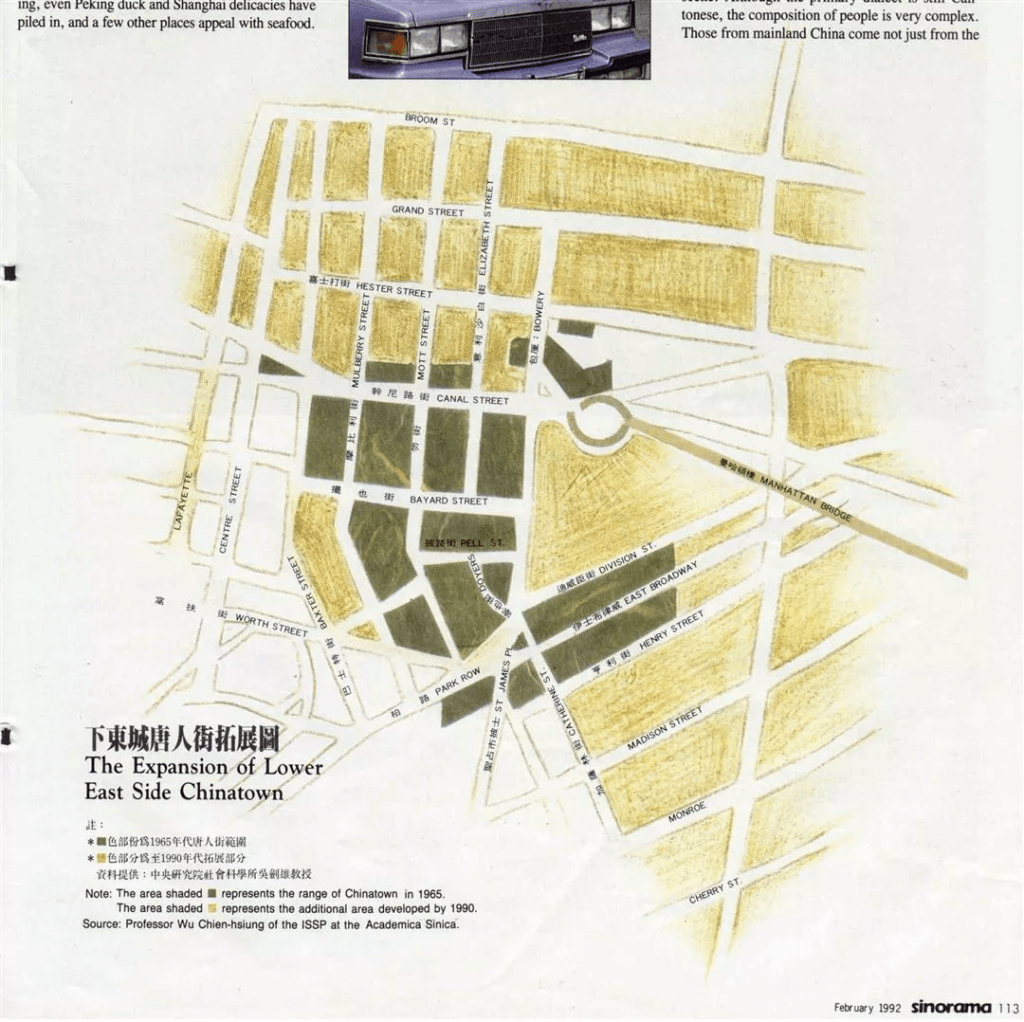
RH: A first concern lies in the question of naming. By titling the film This is Not Chinatown, the filmmakers invoke a diasporic signifier long associated with earlier waves of Chinese migration to Europe, which is also amplified by the choice of title’s corresponding Chinese translation: 这不是唐人街. ‘Chinatown’ here functions not only as a geographical space but also as what Stuart Hall (1990) calls a ‘signifier of identity’, a condensation of historical memory and cultural visibility: Zeedijk – the Amsterdam’s ‘Chinatown’ – is historically closely intertwined with the hustling life of (Indonesian/Surinamiese-)Chinese worker migrations with a Cantonese descent (Rath et.al., 2017). Some of its oldest Cantonese restaurants and tokos1 have survived the difficult period of the 1970s, when the neighbourhood was occupied by drugs deals and gangs who caused severe security concerns. Despite Zeedijke’s nowadays diversified landscape including various non-Cantonese/Chinese businesses, the old shops’ continuing presence stands as a living testament to the cross generational ties between this neighborhood and the Chinese diaspora community. Yet the film’s protagonists – Mandarin-speaking recent arrivals in Amsterdam pursuing higher education- occupy a very different position from the working-class migrants who built those earlier communities. They also approach the region as temporary nostalgic consumers. With such distinction, it is therefore no surprise for these students to find limited resemblance of themselves in ‘Chinatown’. However, it is also a great shame to leave the reasons behind this sense of alienation unaddressed. To disavow ‘Chinatown’ while simultaneously invoking it risks erasing the historical struggles of a prior generation. It also raises the issue of authority: who has the right to claim or disclaim ‘Chinatown’, on whose behalf is such a claim made?2
This topic came up when an interviewee stated in the documentary that ‘this is not Chinatown’ because of its size – Zeedijk is merely a street instead of a town. After the screening, an audience member pointed out that the literal translation of “唐人街 (Tangren jie)” – as adopted in the title – is ‘Tang (dynasty) people street’, questioning the choice of this term instead of the literal translation of ‘Chinatown’ – “中国城 (zhongguo cheng)”. Interestingly, this concern was overlooked despite two of the four of us, the panelists, having a sinophone background. According to various sources (see ChinaNews3, TaiwanParonama4, Encyclopédie du MEM5), 唐人街 is more historically and widely adopted in sinophone contexts referring to Chinatown: written records of associating Chinese migrants with Tang trace back to the early Qing Dynasty (late 17th century), originating from the Japanese term for Chinese enclaves starting from the prosperous Tang Dynasty period (618-907). This was later commonly adopted by Chinese diaspora, and eventually into 唐人街 coined by Cantoense merchants (Zhi, 1868). The term 中国城 appeared in Chinese-language sources at a later stage, adopted by multilingual elites as the direct translation from the English word ‘Chinatown’ (see Cai, 1933, p12; Lee, [1975] 2010). Nowadays, despite both words being commonly used as the translation for ‘Chinatown’ – regardless of its size. However, during this event, its slight linguistic difference still generated interesting questions. For me, as someone raised in a Cantonese cultural context, it is instinctive to associate the other panelists’ default use of 唐人街 for ‘Chinatown’ with our shared Cantonese-language background, shaped in part by its diasporic influence. Circling back to the previous critique, this translingual matter highlights the documentary’s potential in exploring tensions between old and new generations of Chinese migrants.
LL: The second issue concerns the matter of representation. The film presents one homogenous group of friends, all of whom share similar social and educational trajectories. This amplifies the already existing problem Benjamin Maiangwa (2023) describes as the ‘paradox of diasporic identity’, and Rey Chow (1991, xvi) as ‘prescribed “otherness”’: the tension between the demand for representation of difference and the impossibility of any single group embodying the full heterogeneity of a diasporic formation. Ian Ang (2001, 30) illustrates this with the following anecdote:
[I]t was one day that a selfassured, Dutch, white, middle-class, Marxist leftist, asked me, ‘Do you speak Chinese?’ I said no. ‘What a fake Chinese you are!’, was his only mildly kidding response, thereby unwittingly but aggressively adopting the disdainful position of judge to shift ‘real’ from ‘fake’ Chinese. In other words, in being defined and categorized diasporically, I was found wanting.
By narrowing its focus, the documentary risks conflating the experience of privileged, mobile students with ‘Chinese life’ in Amsterdam more broadly. This overlooks other voices within the ‘Chinese presence’ in the Netherlands, including long-established families, undocumented migrants, and workers within different social contexts.
At the same time, this point of critique is problematic in itself. Apart from the title of the documentary which invokes a specific ‘type’ of migrant living within the Netherlands, no other open claim of ‘summarising’ or identifying ‘the’ experience of Chinese students in the Netherlands could be found in the film. Any representational weight it seems to carry is therefore less the filmmaker’s claim than the viewer’s own projection. As such, the film invites the viewer to become aware of this quest for ‘order’ and their need to ‘summarise’ a plurality of voices and societal positions into one.
RH: Moreover, the film’s methodological approach is characterised by a hesitant critical engagement. While the emphasis on the students’ own voices might be understood as an attempt at participatory representation, the interviews are framed in ways that leave little room for analytical depth. Questions such as why does the film focus this particular group of students, what are the standards for selecting and editing, what message does the documentary try to convey, who is the target audience, why is it valuable for them, are absent. As Stuart Hall (1997) reminds us, representation is never a neutral act but always a site of power, where inclusion and exclusion are negotiated. By leaving the students’ accounts largely uncontextualised, the film risks reproducing surface-level narratives of cosmopolitan selfhood without interrogating the broader structures that shape those narratives. Without clearly stating the producer’s creative intention and rationale behind the production, it underplays the documentary’s potential of tackling extradiegetic societal issues related to the students specifically, as well as the population it intends to centralise.
The Dutch context further complicates the reception of This is Not Chinatown. As Gloria Wekker (2016) illustrates, the ways in which many Dutch citizens envision themselves are marked by a paradox: on the one hand, they recognise a persistence of colonial histories and racialised structures, while on the other hand, a dominant self-image consists of tolerance and colorblindness. The absence of a critical framework in the film risks reproducing precisely this paradox. In this case, it might be the producer’s overt awareness of power hierarchies informed by racial difference that led to an un-critical approach toward the topic, avoiding overtaking the space created for Chinese students by inserting his own opinions. This assumption comes from a short confrontation between the producer and myself (Rui, Chinese): while I expressed my critique towards these Chinese students claiming that ‘this is not Chinatown’ while being oblivious of its significance for the diasporic community, the producer replied that it was his intention to respect the perspectives of interviewees and therefore, he refused to put them under the target of attack. Now, taking our own positionality into account and talking about this, we realise how ones’ positionality could determine researchers’ comfortability with a critical approach to the topic, which was taken for granted at the moment of discussion.
Such intention speaks to the concept of ethics of care – a genuine intention of doing no harm to research participants – in conducting qualitative research, addressing the dilemma of power relation between researcher and informants, and how these different roles have an effect on knowledge creation. Regardless of a more critical (see Hammersley and Traianou, 2014) or supportive (see Reich, 2021) examination of the ethics of care, the researchers’ clear positionality is emphasised as essential in good knowledge production. According to Small, “Reflective or not, there is always some representation of the observer…it is here where lack of reflection has led to inadvertent stereotypes and worse.” (2015, but see Reich, 2021, p579). Therefore, while admiring the producer’s strong sense of care towards his interviewees, a critical examination for his own role in this documentary – thought at first glance might seem to take up space intended for students – would in practice help contextualise the lived experience of interviewees students. As This is not Chinatown is one of few documentaries dedicated to Chinese students’ lives in a European context, and taking into account the producers’ absence of previous affiliation with Chinese culture, this has the great potential of drawing out cross-culture dialogues that currently remained underexplored for a wider general public.
LL: Finally, the documentary also suffers from a lack of conceptual clarity. It goes back and forth between generic questions and specific themes (which also comes from a previous interest in ‘mobility’, linked to a university project out of which this film was developed) without clearly articulating its stakes. The audience is left uncertain as to whether the film is about Chinese forms of migration as a contemporary specificity, its underrepresentation in the Dutch context, or simply about the universal experience of studying abroad. This ambiguity dilutes its analytical contribution.
RH&LL: In sum, This is Not Chinatown illustrates both the promise and the pitfalls of contemporary documentary approaches to migration. As Stuart Hall (1990, 225) reminds us, identity is always a matter of becoming rather than being; the challenge for documentary is to illuminate this process rather than obscure it. At the same time, the documentary as presented to us was itself in a state of becoming rather than being, and as such, it might have been in its most honest, and interesting, stage.
Footnotes
1 Toko: ‘shop’ in Indonesian; a kind of retail shop commonly seen Indonesia and the Netherlands.
2 Map of New York’s Chinatown (1968-1990), sourced from Taiwan Panorama (see footnote 4).
3 “唐人街”前世今生:从“大唐街”到“中国城”, 2009, ChinaNews, Last accessed on 24th Sep., 2025.
4 “永遠的「唐人街」?” by Chen Shumei, 1992, Taiwan Panorama. Last accessed on 24th Sep., 2025.
5 “中国城:满地可唐人街”, by Olivier Paré, 2017. Last accessed on 24th Sep., 2025.
References
Ang, Ien, 2001. On Not Speaking Chinese: Living Between Asia and the West, Routledge
Chow, Rey, 1991. Woman and Chinese Modernity, University of Minnesota Press
Cai, Yunchen, 1933. Lv’e riji ejing lvhua hekan 旅俄日記·俄京旅話合刊 [=Travel Diary in Russia· Travel Talks in Moscow].
Hall, Stuart, 1990. ‘Cultural Identity and Diaspora’, in Jonathan Rutherford (ed.), Identity: Community, Culture, Difference, Lawrence & Wishart
Hall, Stuart (ed.), 1997. Representation: Cultural representations and signifying practices. Sage Publications
Hammersley, M., & Traianou, A, 2014. ‘An Alternative Ethics? Justice and Care as Guiding Principles for Qualitative Research’, Sociological Research Online, 19(3), 104-117
Lee, Ou-fan, 2005. Xichao de bi’an 西潮的彼岸 [= Notes From the Other Shore], Nanjing Shi : Jiangsu jiao yu chubanshe 南京市:江苏教育出版社. Originally written in 1975.
Maiangwa, Benjamin (ed), 2023. The Paradox(es) of of Diasporic Identity, Race and Belonging, Palgrave Macmillan
Reich, J.A., 2021. ‘Power, Positionality, and the Ethic of Care in Qualitative Research’, Qual Sociol, 44, 575–581
Rath, Jan, Annemarie Bodaar, Thomas Wagemaakers, and Pui Yan Wu, 2017. ‘Chinatown 2.0: The Difficult Flowering of an Ethnically Themed Shopping Area’, Journal of Ethnic and Migration Studies, 44 (1): 81–98
Wekker, Gloria, 2016. White Innocence: Paradoxes of Colonialism and Race.


Leave a Reply