
Food, Memory, and Embodied Self-Portraits among Taiwanese Migrants in Europe
by Hsiao-Chi Chu
A Situated Fragment
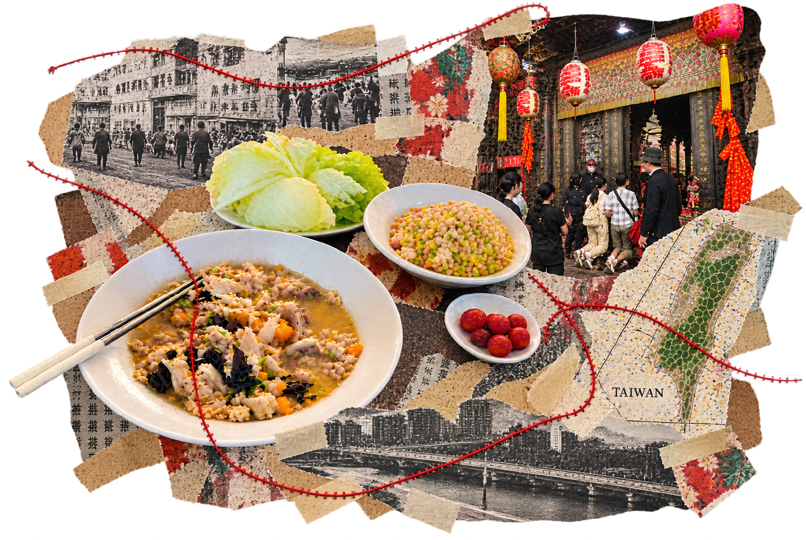
Between August and September 2026, I joined several Taiwanese community gatherings in the Netherlands. I see these encounters not as representative of Taiwanese migration in Europe as a whole, but as situated fragments within a longer artistic inquiry.
Being Taiwanese myself, I am also part of this field. The experiences shared in these gatherings are distinctly situated in Taiwanese identity and migration, while also overlapping with wider Sinophone and Asian contexts through language, food, festivals, cultural memory, and everyday life. These overlaps do not make those experiences the same. They can exist alongside a desire to be recognised as Taiwanese rather than being folded into a single “Chinese” identity.
In the conversations, people kept returning to everyday things:
“What connects me to Taiwanese culture is the language, the accent, and the food.”
“For me, food comes first.”
“The strongest connection for me is the language we share.”
At the same time, another participant described being seen by Dutch friends as simply “another Asian.”
What interests me is how the same material can sit in two places at once.
Food can be a stereotype seen from the outside, but it can also be a sensory memory from within. Language can be something others assume we speak, but also something we choose to keep using in a new place. An accent can mark someone as foreign, while making someone else suddenly feel at home.
Food kept returning in our conversations. For me, food is never just a cultural symbol. It lives in shopping, chopping, cooking, seasoning, eating together, and in the body remembering how something is supposed to taste.
A dish may be publicly recognised as “Taiwanese,” yet privately carry family memory, everyday routine, movement, adaptation, or care.
So a photograph of food is not only a record of a meal.
It can also become a self-portrait made through taste, repetition, and memory.
Stitching as a Method
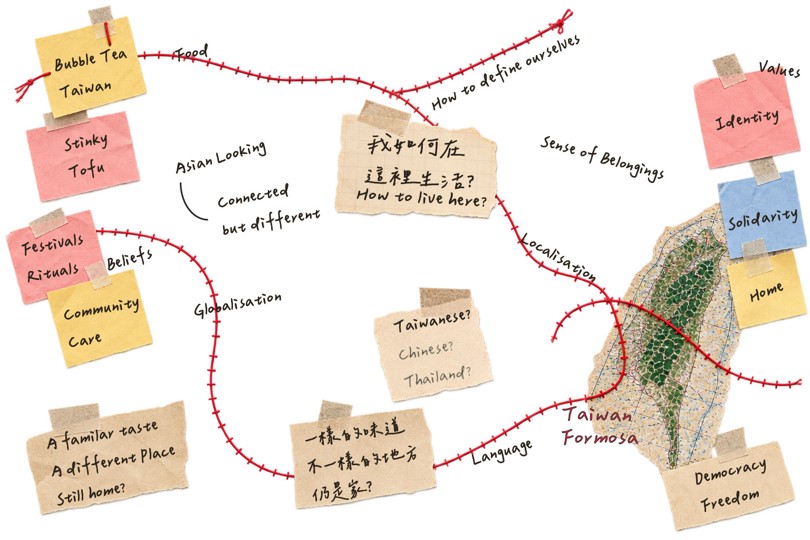
In my original proposal, I imagined food, textiles, embroidery, the body, and memory as interconnected archives of migration.
The fieldwork made me realise that stitching does not need to appear literally as embroidery in every story. It can become the method of the work.
A stitch does not pretend that two pieces of fabric were always one. It holds them together while leaving the seam visible.
I approach the materials in the same way. Food memories, anonymous conversations, handwritten notes, sounds, names, objects, and gestures can be layered together to articulate a Taiwanese sense of identity and belonging, while keeping visible the overlaps, tensions, and seams that connect it to wider Sinophone and Asian experiences.
Rather than dissolving these differences into a single identity, I want the work to keep the seams visible: where experiences meet, where they overlap, and where they remain distinct.
The images become a kind of assembled self-portrait: incomplete, overlapping, and still open to change.
The stitch holds fragments in relation without making them seamless.
A portrait may be a face.
But it may also be a bowl carried to a table,
a name spoken in its own sound,
or a stitch holding places together without erasing the seam.
Artwork and text: Hsiao-Chi Chu, 2026.
Field material from Taiwanese community gatherings in the Netherlands, August–September 2026. Participant excerpts anonymised. Courtesy of the artist.
If any individual source image or archival element requires a separate credit, please add that source-specific credit before publication.
Copyright Chinese Selfies in Europe (Franziska Plümmer & Linde Luijnenburg), 2026.

