
by Xu Yiqin
Remaking the Narrative of Creativity and Industrialization
This is my second time at the Wereldmuseum in Amsterdam after a rather rushed previous visit, so I took another look at the permanent exhibition area before heading to the “Made in China” exhibition. I like the classic architectural style of this building, which was originally built to celebrate colonization but now aims to rethink history and world culture through a decolonial lens. Perhaps because Chinese New Year had recently passed, the red lanterns from the festivities were still hanging in the main hall. This traditional Chinese element creates a distinctive contrast with the building’s generally western and somber atmosphere. Positioned directly opposite the lanterns, the “Made in China” poster is displayed on the second floor.
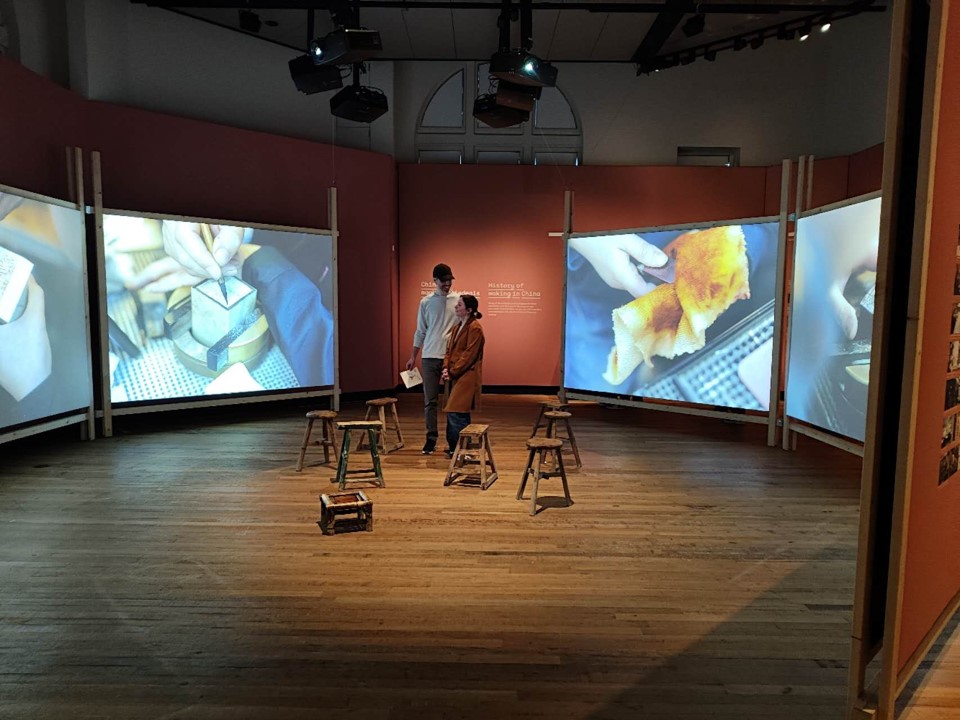
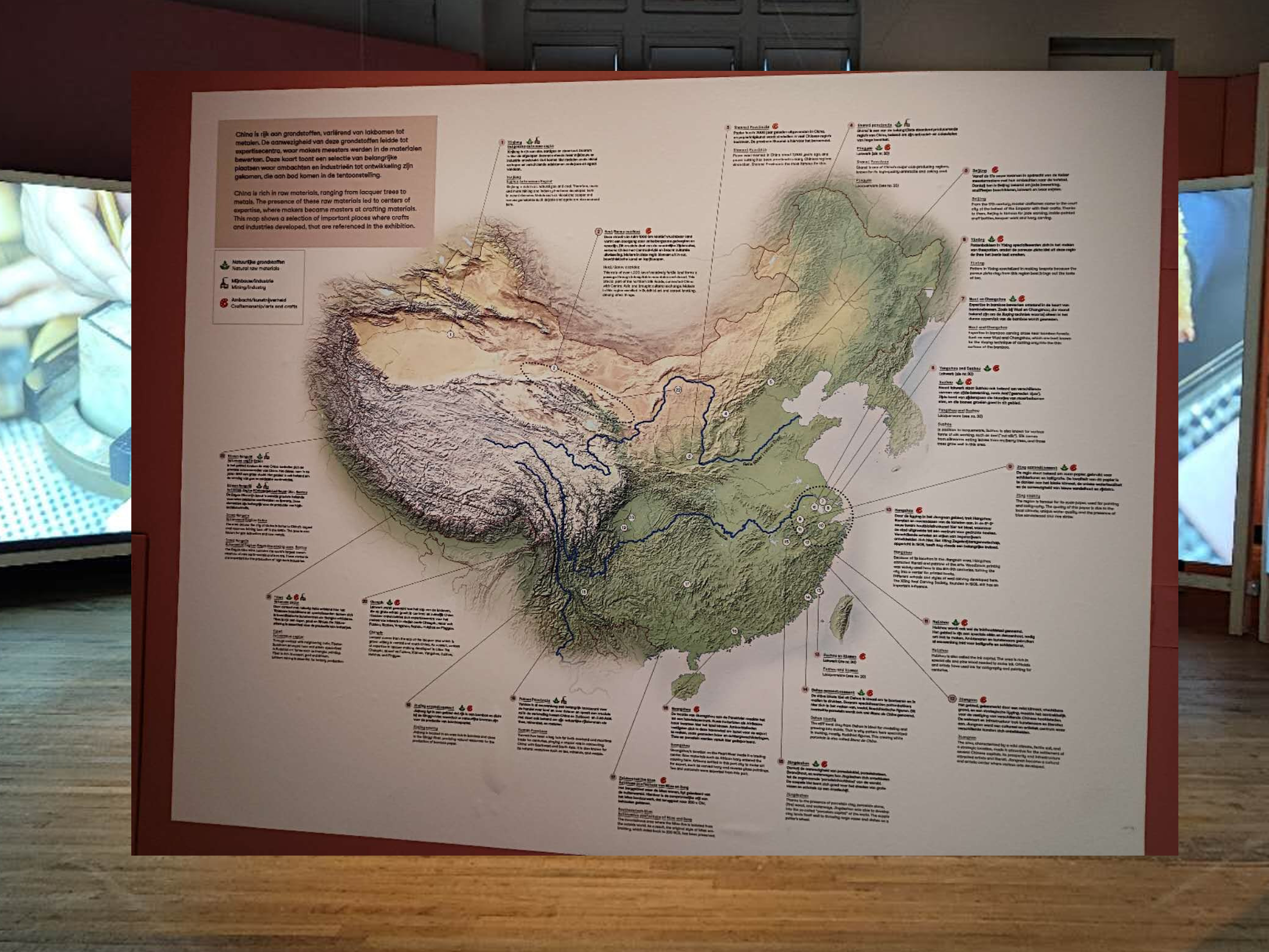
Stepping into the exhibition’s first section, a circular space surrounded by projected screens was furnished with wooden stools (木板凳) that exuded a “Chinese dream core (中式梦核)” vibe (figure 1). While such stools are ubiquitous and unremarkable in rural China, seeing them in a Dutch museum felt surprisingly fresh. Crafted without nails using traditional mortise-and-tenon joints (榫卯), they embody a simple yet pragmatic craftsmanship; however, these kinds of artifacts seem to have been replaced by modern alternatives in today’s cities. Seeing these small, worn-down stools, with their exposed wood texture, reminds me of elderly people sitting in Chinese rural courtyards, cracking sunflower seeds or sorting vegetables. I can’t help but wonder where they brought these aged pieces from. I also noticed a map of China marked with the locations of the crafts and industrial developments mentioned in the exhibition (Figure 2). I am quite familiar with this map, but my European friend asked me why the Northwest region was only noted for its raw material resources like coal, gas, and jade, while the Northeast region of China was not mentioned at all. Perhaps the Northeast represents the old industrial “Made in China” (heavy industry/state-owned), which doesn’t fit the museum’s “craft/creative” narrative. This omission echoes the museum’s description in its permanent exhibition that colonial knowledge transfer often rendered certain local realities “invisible.” Does this mean that the representation of “making” featured in the exhibition is based on a romanticized vision? This question led me to examine the map’s details more closely, and I began to wonder about the exhibition’s focus on “Making/maker”: How does it define and distinguish between Chinese craft, industry, and art? Which of these domains do the selected artifacts and topics aim to understand and interpret?
In the same room, there is a chronological “History of Making in China.” For the ancient period, it emphasizes “the oldest” and “the first,” showcasing inventions from China. However, the display of modern history after the nation’s founding feels somewhat rushed: in the historical timeline, for example, the Reform and Opening-Up and the wave of industrialization from the 1980s are only mentioned in a single sentence. However, the past few decades have actually shaped the “Made in China” label. During this phase, “making” became dynamically intertwined with the economy, politics, and society at large. The crafts and manufactures are influenced by national and local policies, and are also more closely integrated with export trade. Interestingly, the final entry stops at 2016, mentioning that China has over 300,000 design graduates annually. Compared to the historical stages or significant events in other entries, my interpretation of this particular mention is: a massive number of design graduates are flooding into the job market; perhaps most cannot pursue creative artistic work, instead becoming part of the “Made in China” manufacturing wave. I believe these statistics actually hold many vivid stories and may resonate with the exhibition’s final section titled “Makers of Today.” Will those young graduates become artists, craftspeople, or workers in today’s China?
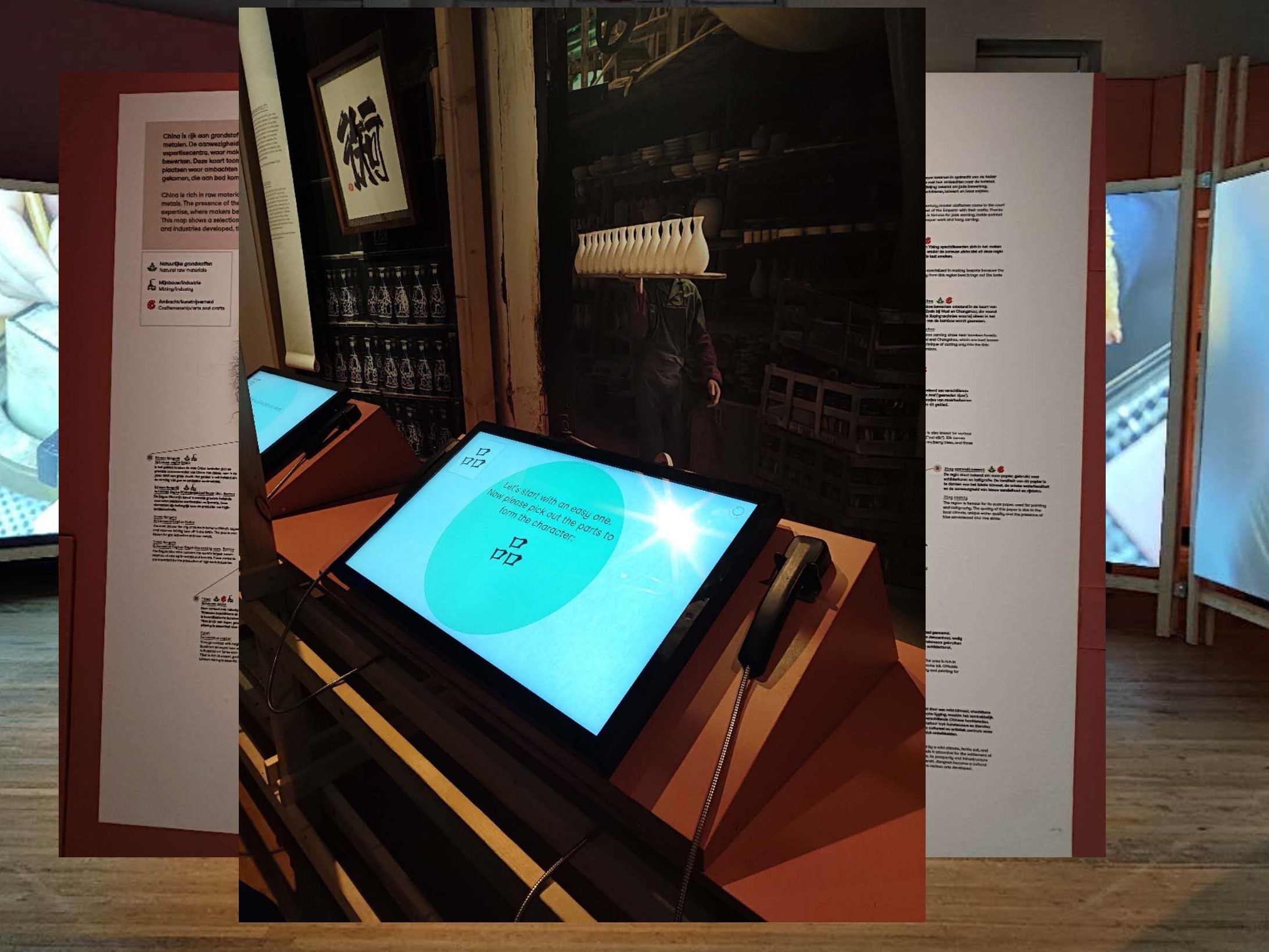
Perhaps influenced by the curator’s academic background, I found that this exhibition places a strong emphasis on the materials used in the making process. For instance, in another impressive section, the display is guided by “materials and techniques” rather than the conventional approach of organizing exhibits by theme or timeline. Although I was a bit confused by this way of guiding the visitors’ movement when I first visited, upon revisiting this time, I found it might also be an iterative and flexible way of presenting. This section also features many tactile, visual, and video-based interactive pieces, for example, touching a calligraphy brush (毛笔), mahjong tiles (麻将牌), and a lacquer vase. I think this offers an engaging experience for non-Chinese visitors. My foreign friend lingered for a while at the “Chinese Characters” digital interaction, trying to “piece together” characters by combining radicals. But afterward, he asked me: how does this relate to making or craftsmanship? The exhibit’s introduction mentioned that Chinese characters and calligraphy show “how repetition can be used creatively and systematically to produce thousands of unique characters.” I find this interpretation of Chinese characters to be very interesting and insightful, offering me a different perspective. But as a native speaker, I still find this claim a bit puzzling: Chinese characters, just like the alphabet’s letters, are a written form of language. Perhaps from a Western perspective, Chinese characters are viewed as “graphics” rather than “symbolic/semantic” forms. In the context of alphabetic systems, logograms become “products” to be decomposed. I believe this is a way to help non-Chinese audiences understand characters, but not to be regarded as “a means of production”. While the museum’s permanent exhibition claims to value “Native Knowledge”, the digital interaction seems to revert this by deconstructing a non-Western language into a visual curiosity rather than a carrier of complex wisdom.
In the “mass production” section, the exhibition clearly places greater emphasis on the industrial aspect. What struck us was the consequences of industrialization for China (“At what cost?”), particularly regarding labor conditions and environmental impact. In China, industry and manufacturing have conventionally been granted a “near-sacred” status through political propaganda: they embody the value of “Workers as Masters” (工人阶级当家作主), and rapid industrial growth is viewed as success in modernization. I greatly appreciate how this exhibition gathered specific stories of individuals, because what is often overlooked behind mass-produced commodities are the stories of real people, especially their struggles and reflections. At the same time, however, this may reinforce the stereotypes associated with “Made in China”—resource depletion, labor exploitation, and unsustainability. As far as I know, these issues have been repeatedly highlighted in Western media. While I believe it is essential to acknowledge these negative impacts and seek for possible solutions, I also think they are often exaggerated for geopolitical interests. Although the “costs” of production should be widely acknowledged, it simplifies China’s role as a global infrastructural builder and manufacturer. As a developing country, China has indeed encountered numerous detours and setbacks during its industrialization over the past few decades. However, this is not merely a problem faced by a single nation; as the “world’s factory,” it bears the costs for the supply chains of the Global North. Instead of placing Western-led critiques of development at the center, the exhibition could further explore the complex realities of the shifting global power dynamics. Environmental and labor rights issues have gained widespread attention in China, as people begin to confront real-world challenges beneath the “National Rejuvenation” narrative and propaganda.
In the subsequent section, the exhibition shows contemporary creative works in China, such as fashion design and popular video games, which seem to form a sharp contrast with the “victims” of industrial development. However, I find that those involved in the “creative industries” and “mass production” are not necessarily the binary opposites. In reality, they often face similar challenges, yet possess equally remarkable creativity. As mentioned earlier regarding employment challenges, many creative young designers struggle to utilize their talents, while in the craft and manufacturing sectors, many people are also generating new innovations, especially in today’s digital media era. This brings us back to the question of how we should define artists, craftspeople, and workers in contemporary China. In my view, they collectively constitute the essence behind the “Made in China” label.
The “Made in China” exhibition humanizes a label often dismissed as cheap or mechanical, yet it sometimes remains caught in the traditional tensions. In the context of “making”, the designers, the craftspeople, and the factory workers often inhabit the same economic ecosystem. To define the maker today is not to choose between art and industry, but to acknowledge the collective struggle, resilience and innovation from diverse groups. The story of making may be found in the blurred and dynamic lines that define contemporary China’s struggle for self-representation on the global stage.

