

by Xu Yiqin
As social media becomes embedded in everyday life, RedNote (Xiaohongshu, 小红书) emerges as an essential lens to understand the social dynamics and information sources of the new-generation Chinese migrants. Launched in China in 2013, this evolving platform primarily features user-generated content (UGC) in the form of “image + text” posts (referred to as “notes”), alongside short-form video and e-commerce functions. Driven by its powerful personalized algorithms and diverse content categories, this lifestyle-sharing platform increasingly functions as “everyday infrastructure” for migrants (Kang and Yu, 2026). Its overseas user base—mainly students and young professionals living abroad—contributes vast amounts of content covering extensive topics: networking, lifestyle, recommending local and travel activities. These algorithm-driven online communities provide not only the practical information necessary for navigating life in Europe but also a critical digital connection to the homelands.
RedNote features rich content related to overseas lifestyles, providing both imagination and practical information for new Chinese migrants. Because global platforms like Google or Instagram are less accessible within Mainland China, RedNote often serves as the primary window into European life during the pre-migration phase. Vlogs and “notes” shared by users already residing in third countries shape the expectations of prospective migrants and serve as reference points for their future choices. Its role is even more significant in the settlement phase, often serving as a “survival guide” for newcomers. By leveraging peer-shared knowledge, newcomers find practical advice for questions like: how to open a bank account in the Netherlands, where to find authentic Sichuan food in Paris, or navigating visa bureaucracies in different countries (Figure 1). Consequently, RedNote’s role as a UGC hub has, to an extent, superseded traditional migration agencies, official websites, and community centers.
Many users rely on RedNote to build online or offline communities and personal connections. The high mobility and inherent precarity of migration often necessitate that individuals establish new social ties within their host environments. Online practices based on self-expression (i.e. posting and commenting) and social behaviours (i.e. sharing useful advice) open up new opportunities for interpersonal connections, such as private messaging, exchanging contacts, or joining communities. RedNote presents a new perspective for further research on Chinese migrants in Europe, while also inviting reflection on issues of privacy, digital reliance, and the potential challenges to social integration posed by algorithm-driven digital enclaves.
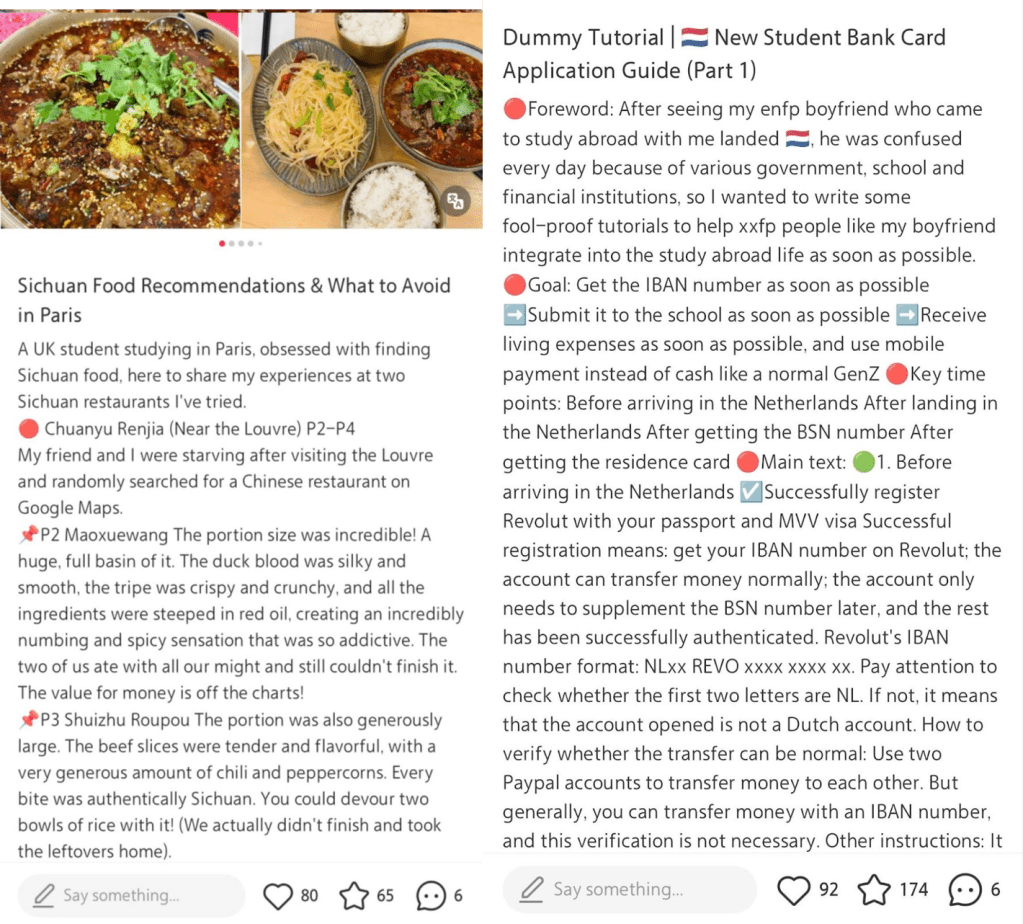
Figure 1. Screenshots of sample posts from search results using keywords “Sichuan food in Paris (巴黎川菜)” and “applying for a Dutch bank account (办荷兰银行卡)”. Translated by RedNote’s built-in translation function.
 Chinese Selfies in Europe